Begin of page section:
Page sections:

  • Go to contents (Accesskey 1)
  • Go to position marker (Accesskey 2)
  • Go to main navigation (Accesskey 3)
  • Go to sub navigation (Accesskey 4)
  • Go to additional information (Accesskey 5)
  • Go to page settings (user/language) (Accesskey 8)
  • Go to search (Accesskey 9)

End of this page section. Go to overview of page sections

Begin of page section:
Page settings:

English en
Deutsch de
Search
Login

End of this page section. Go to overview of page sections

Begin of page section:
Search:

Search for details about Uni Graz
Close

End of this page section. Go to overview of page sections


Search

Begin of page section:
Main navigation:

Page navigation:

  • University

    University
    • About the University
    • Organisation
    • Faculties
    • Library
    • Working at University of Graz
    • Campus
    Developing solutions for the world of tomorrow - that is our mission. Our students and our researchers take on the great challenges of society and carry the knowledge out.
  • Research Profile

    Research Profile
    • Our Expertise
    • Research Questions
    • Research Portal
    • Promoting Research
    • Research Transfer
    • Ethics in Research
    Scientific excellence and the courage to break new ground. Research at the University of Graz creates the foundations for making the future worth living.
  • Studies

    Studies
    • Prospective Students
    • Students
  • Community

    Community
    • International
    • Location
    • Research and Business
    • Alumni
    The University of Graz is a hub for international research and brings together scientists and business experts. Moreover, it fosters the exchange and cooperation in study and teaching.
  • Spotlight
Topics
  • Sustainable University
  • Researchers answer
  • Work for us
Close menu

End of this page section. Go to overview of page sections

Begin of page section:
You are here:

University of Graz Cancer Biophysics Research Development of new peptid-based therapies
  • Research
  • Team
  • Publications
  • Teaching
  • Contact

End of this page section. Go to overview of page sections

Begin of page section:
Sub navigation:

  • Research
  • Team
  • Publications
  • Teaching
  • Contact

End of this page section. Go to overview of page sections

Development of novel targeted therapies

- based on peptides of the innate immune system

Our focus is on:

  • Lactoferricin-derived peptides for cancer therapy

  • PS-specific peptides for cancer therapy

  • Targeting-peptides for selective drug delivery of cancer drugs

The investigated peptides are derived from the human innate immune system. More precisely from lactoferrin/lactoferricin, found in breast milk or exocrine secretions, which is highly important for antimicrobial and antitumour defence. These peptides are enhanced in their interaction with cancer cell membranes to enable the step from a defence to a therapeutic indication.

Targets of these newly developed antitumour peptides can be lipids such as phosphatidylserine, which is commonly exposed on cancer cell membranes.

In more recent studies, we are also targeting the receptor Gb3 (globotriaosylceramide), which is overexpressed on cervical cancer, for example. The effect on Gb3+ tumours is achieved by fusing the peptides with lectin.

Publications:

Riedl et al, 2014, 2015, 2017,doi: 10.1007/s10534-014-9749-0doi: 10.1016/j.bbamem.2015.07.018doi.org/10.18632/oncotarget.17823 Wodlej et al, 2019,doi: 10.1371/journal.pone.0211187 Grissenberger et al, 2020,doi.org/10.1016/j.bbamem.2020.183264 Maxian et al, 2021,doi: 10.3390/ijms22168469 Wussmann et al, 2022,doi: 10.3390/biomedicines10112961. Pasupuleti et al, 2023,doi: 10.1002/pro.4830.
 

Positively charged peptides derived from the innate immune defence can specifically target negatively charged cancer cell membranes and induce programmed cell death in the cancer cell ©S. Riedl, PEP-fold
©S. Riedl, PEP-fold
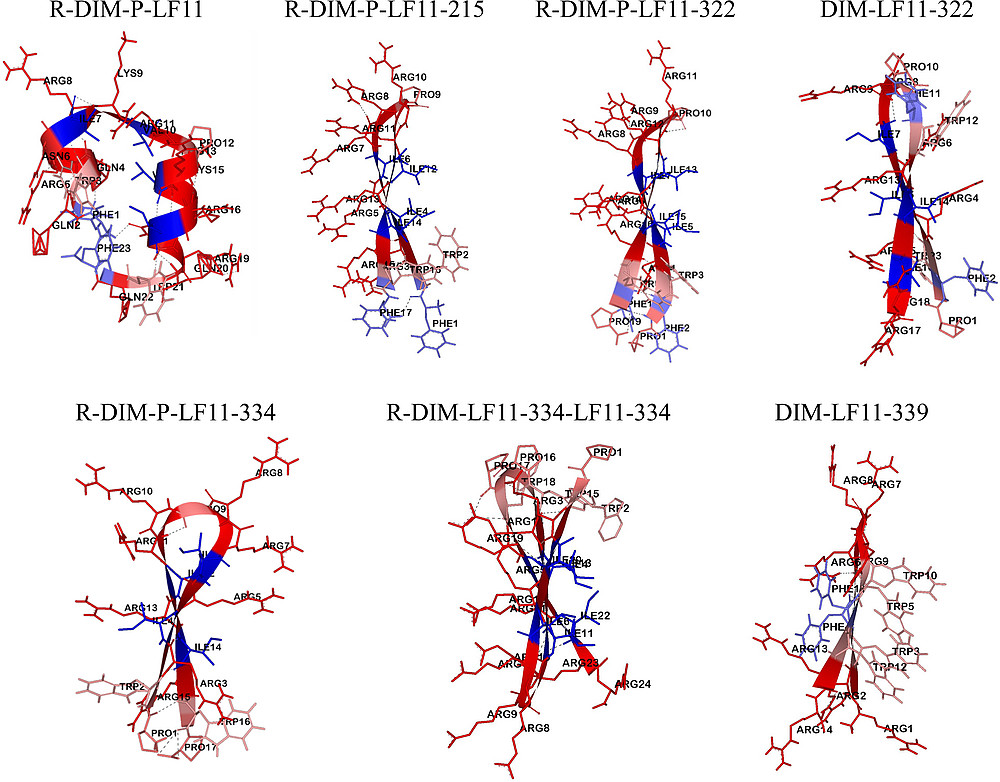
PEP-fold structure simulations of antitumour peptides developed in our laboratory, derived from lactoferricin, a defence peptide from breast milk.
Design: S. Riedl, data via PEP-fold

Begin of page section:
Additional information:

University of Graz
Universitaetsplatz 3
8010 Graz
Austria
  • Contact
  • Web Editors
  • Moodle
  • UNIGRAZonline
  • Imprint
  • Data Protection Declaration
  • Accessibility Declaration
Weatherstation
Uni Graz

End of this page section. Go to overview of page sections

End of this page section. Go to overview of page sections

Begin of page section:

End of this page section. Go to overview of page sections