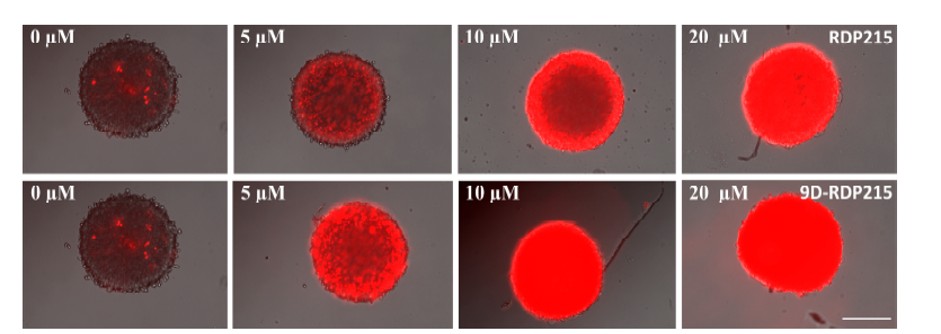
Design: L. Gerlitz, D. Zweytick, data from Maxian et al, Biomedicines (2021), licence: CC-BY 4.0
Innovative model studies
- to investigate the efficacy, specificity and mechanisms of action of new cancer therapeutics
Models used:
Liposome-based cancer and non-cancer mimics for the optimisation of lipid-targeting peptides
In vitro 2D cancer and non-cancer cell cultures to identify cancer-specific peptides, including studies on patient-derived cells (collaboration with Beate Rinner, Pathology, MUG)
In vitro 3D cancer and non-cancer cell cultures to better mimic in vivo conditions and investigate peptide penetration and effects on tumour spheroids with and without tumour stroma
Blood-brain barrier models for the development of peptide drugs for neurological tumours
Immune system models to investigate the immunomodulatory effects of peptides
Organoid models, in cooperation with Beate Rinner (Pathology, MUG) and Florian Kai Gröber-Becker (Fraunhofer Institute for Silicate Research, Würzburg, Germany)
In vivo human and mouse models at the Medical University of Graz (Beate Rinner, Pathology, MUG)
Publications:
Riedl et al, 2014, 2015, 2017,doi: 10.1007/s10534-014-9749-0doi: 10.1016/j.bbamem.2015.07.018doi.org/10.18632/oncotarget.17823 Wodlej et al, 2019, doi: 10.1371/journal.pone.0211187 Grissenberger et al, 2020, doi.org/10.1016/j.bbamem.2020.183264 Maxian et al, 2021, doi: 10.3390/ijms22168469 Wussmann et al, 2022, doi: 10.3390/biomedicines10112961.